
China Smart Glasses Market — 2026
Abhishek Sharma
September 20, 2026
Executive Summary
A Bloomberg report published September 20, 2026 says China’s sales of smart glasses on key platforms more than doubled during January–August 2026. The report places this growth within a broader shift in Chinese consumer demand toward technology-enabled products and services.
The wider market data points to a rapidly expanding smart-eyewear market. RUNTO data reported 909,000 smart-glasses units sold across China in H1 2026, up 85.5% year over year, with sales value up 98.7%. AR glasses were a particularly strong segment in the cited July data.
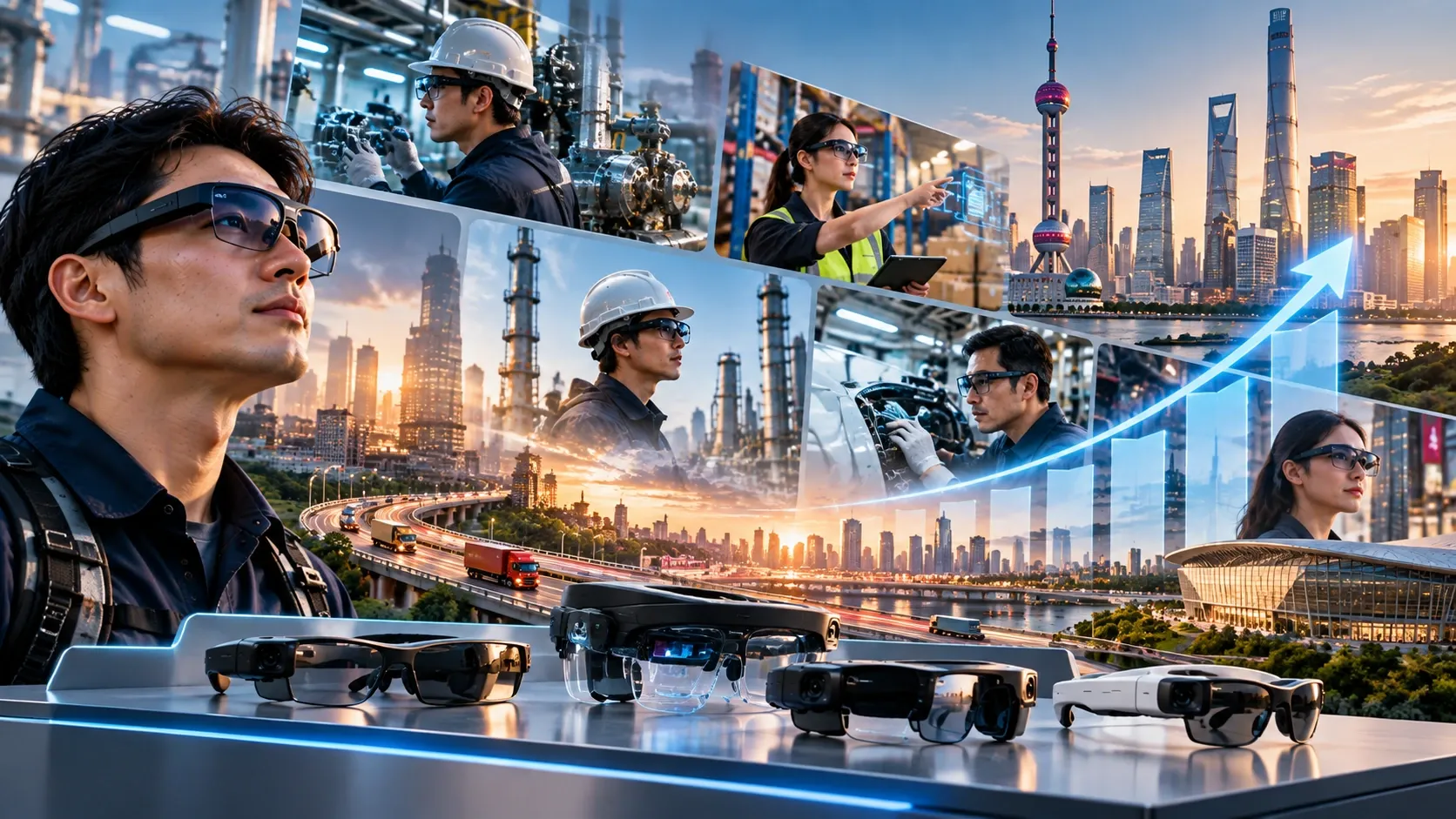
For enterprise technology, the significance goes beyond consumer adoption. Smart AR glasses are becoming a practical interface for frontline work—connecting workers to digital instructions, AI knowledge, remote experts, computer vision and real-time operational data without requiring workers to repeatedly look down at phones, tablets or paper manuals.
Key Bloomberg-report figures
Metric | Reported result |
|---|---|
Smart-glasses sales, Jan–Aug 2026 | More than doubled on key Chinese platforms |
Action-camera sales, Jan–Aug 2026 | About +27% |
Service retail sales, Jan–Aug 2026 | +4.9% |
Goods vs. services | Services grew 3.9 percentage points faster |
Petroleum-product sales | −6.1% |
Rural retail sales | +2.3% |
Bloomberg article — detailed summary
The Bloomberg report focuses on Chinese consumer-market data for the first eight months of 2026. The Ministry of Commerce reported that smart-glasses sales on key platforms more than doubled. The report also mentions growth in other technology-oriented product categories, including action cameras.
The article places the smart-glasses increase within a broader change in Chinese consumption. Service retail sales grew 4.9% from January through August, outperforming goods retail growth by 3.9 percentage points. The report also notes a 6.1% decline in petroleum-product sales and 2.3% growth in rural retail sales.
Important interpretation: the Bloomberg report uses sales on key platforms rather than a comprehensive national shipment measure. Therefore, its “more than doubled” figure should not be treated as identical to total Chinese smart-glasses market growth.
China Smart-Glasses Market Analysis
1. H1 2026 market size and growth
RUNTO data reported by Chinese technology media indicates that China’s smart-glasses market sold approximately 909,000 units across online and offline channels in H1 2026, an 85.5% year-over-year increase.
Sales value reached approximately RMB 1.88 billion, up 98.7%.
This provides a useful market-wide counterpoint to the Bloomberg/MOC platform-sales figure: both indicate strong growth, while using different measurement periods and methodologies.
2. The market is splitting into product categories
Category | Recent evidence |
|---|---|
AR glasses | H1 growth led the market; July online sales +72.7% YoY in RUNTO data |
Audio glasses | July online sales −16.6% YoY |
Camera glasses | July online sales −46.6% YoY |
AR + AI direction | Lightweight AI-enabled products are emerging alongside more capable spatial-computing devices. |
3. Why AI + AR glasses matter for industry
The industrial opportunity is different from consumer smart glasses. In factories, plants, field-service environments, aircraft maintenance, energy facilities and other mission-critical settings, the value of an AR headset comes from putting the right information directly in the worker’s field of view at the moment it is needed.
AR glasses can provide hands-free access to work instructions, manuals, checklists, images, videos, 3D models and live expert guidance. AI can make that information conversational and context-aware, while Computer Vision can help validate parts, tools and task execution. Together, these technologies can turn the wearable from a display device into an operational interface for the frontline workforce.
AR Genie — at the forefront of AI-powered enterprise AR
AR Genie is positioned at the intersection of enterprise Augmented Reality, AI, Computer Vision and smart AR glasses. Its platform is designed specifically around frontline operations rather than treating AR glasses as a standalone hardware product.
AR Genie integrates its software with multiple enterprise AR-glass platforms, including Magic Leap 2, HoloLens 2, Vuzix, RealWear and other supported devices, while also supporting iPads and other mobile endpoints.
The AR Genie platform brings together Work Assist, Remote Assist, Smart Assist and Training.
Work Assist converts procedures and operational knowledge into step-by-step AR workflows.
Remote Assist enables experts to see what the frontline worker sees and provide real-time visual guidance.
Smart Assist uses AI to make technical manuals and knowledge bases interactive.
Training combines AR, AI, Generative AI and Computer Vision for immersive workforce development.
This creates an important distinction: AR Genie is not simply putting digital content on smart glasses. It is building an intelligent operational layer around the glasses—connecting people, procedures, enterprise knowledge, AI and the physical environment.
Its Work Assist platform can deliver instructions, 3D models, images and videos through AR glasses and can use Generative AI to help create and retrieve work instructions from manuals and knowledge bases.
AR Genie’s Smart Assist further extends this model by transforming technical documentation into conversational, context-aware AR guidance.
Its Training solution adds Computer Vision-based validation and performance analytics, creating a path from training to actual on-the-job execution.

4. What the trend means for industries
Industry | Potential impact of AI + AR glasses |
|---|---|
Manufacturing | Hands-free assembly, maintenance, inspection, quality checks and faster issue resolution; less dependence on paper instructions. |
Automotive & EV | Guided assembly, diagnostics, inspection, technician training and remote assistance for increasingly software- and electronics-heavy vehicles. |
Aerospace & Defense | Step-by-step maintenance, inspection, remote expert support, technical documentation and training where accuracy and traceability are critical. |
Oil & Gas / Energy | Remote support for field assets, maintenance guidance, inspections and access to technical information in difficult or hazardous environments. |
Heavy Industry / Cement | Equipment maintenance, plant inspections, troubleshooting, operator training and expert support to reduce disruption and downtime. |
Logistics & Field Service | Hands-free job instructions, asset identification, troubleshooting and remote support while workers remain mobile. |
Healthcare / Technical Services | Potential for guided procedures, equipment servicing, technical training and remote specialist assistance, subject to applicable safety and regulatory requirements. |
5. The shift from “AR hardware” to an intelligent frontline platform
The next stage of industrial AR is likely to be defined less by the glasses alone and more by the intelligence and workflow platform behind them.
Enterprises need the wearable to connect with procedures, knowledge repositories, experts, IoT/operational data and existing digital systems. This is where AI-powered AR platforms can create a larger operational impact than a standalone headset.
For AR Genie, this market shift aligns closely with its product direction: use AR glasses as the worker interface, AI and Generative AI as the knowledge and assistance layer, Computer Vision as a validation and perception layer, and enterprise workflows as the execution layer.
Key Takeaways
- China’s smart-glasses market is expanding rapidly in 2026, with the Bloomberg/MOC report showing platform sales more than doubling in January–August.
- RUNTO’s H1 data indicates 909,000 units sold and 85.5% YoY growth across China’s online and offline market.
- AR glasses are showing stronger momentum than audio-only or camera-only categories in the cited July data.
- AI, lightweight form factors and practical use cases are becoming central to the next phase of smart-eyewear adoption.
- For industry, the bigger opportunity is an intelligent frontline platform that combines AR glasses with AI, Computer Vision, workflows, enterprise knowledge and remote expertise.
- AR Genie is focused on this enterprise layer, using AR glasses as a hands-free interface for Work Assist, Remote Assist, Smart Assist and Training across industrial workflows.
Sources & methodology
Primary article: Bloomberg, “China’s smart-glasses sales double in first eight months of year,” September 20, 2026. The Bloomberg report was accessed through a syndicated Moneycontrol version.
Market data: RUNTO figures reported in September 2026 for China’s smart-glasses market; IDC Q2 2026 smart-glasses/XR tracking for global context. Figures use different definitions and measurement periods.
AR Genie information: AR Genie’s official product and company materials describing Work Assist, Remote Assist, Smart Assist, Training, supported AR glasses and industrial use cases.